Best Coolant for Diesel Trucks by Engine Type
A low-coolant warning on a diesel truck is never just a warning light. It can be the first sign of corrosion, liner damage, a leaking component, or a cooling system that is no longer protected for the work it does. The best coolant for diesel trucks is not determined by color or price. It is the coolant chemistry that meets your engine manufacturer’s specification, protects the system’s materials, and fits your maintenance plan.
For an owner-operator, that choice protects a truck that has to make its next delivery. For a shop or fleet, it helps control downtime, repair exposure, and the cost of avoidable cooling-system failures. The right coolant is a maintenance decision, not a commodity purchase.
What Makes the Best Coolant for Diesel Trucks?
A diesel cooling system works harder than many operators realize. It has to carry heat away from combustion chambers, protect aluminum components and radiators, prevent scale, lubricate water-pump seals, and resist corrosion for years of service. Heavy-duty engines with wet cylinder liners have another concern: cavitation erosion.
Cavitation occurs when vibration and pressure changes create tiny vapor bubbles against the outside of a wet liner. When those bubbles collapse, they can gradually pit the liner wall. Left unmanaged, liner pitting can progress to coolant entering the combustion chamber or crankcase. That is a major repair, and it is exactly why coolant chemistry and maintenance intervals matter in heavy-duty diesel service.
The right product must meet the OEM coolant requirement listed in the owner’s manual or service literature. That specification takes priority over a general claim that a coolant is suitable for “all makes and models.” A universal product may be appropriate when it specifically meets the required standard, but it should never be selected solely because the jug is the same color as the coolant already in the reservoir.
Coolant color is not a specification
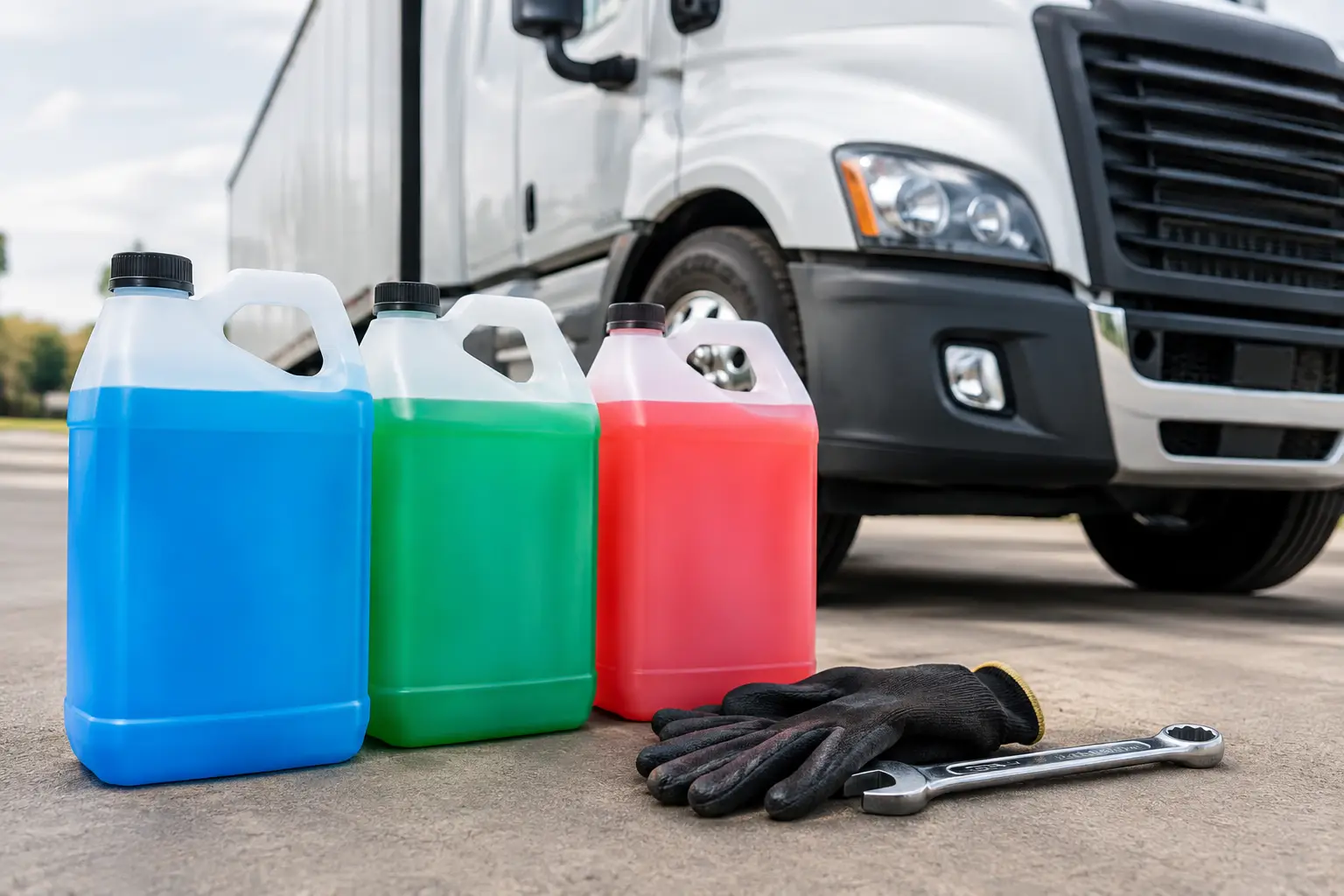
Green, red, orange, yellow, purple, and blue coolant can represent different inhibitor packages depending on the manufacturer. Two red coolants can have entirely different chemical formulas. Mixing based on color can weaken corrosion protection, shorten service life, or create a maintenance program nobody can accurately track afterward.
Read the label for the actual approvals, recommended applications, and coolant technology. If the truck’s service history is unknown, identify what is in the system before topping it off. When that is not possible, a complete drain, flush, and refill with one approved chemistry is usually the safer long-term decision.
Know the Main Diesel Coolant Technologies
Most diesel truck owners will encounter conventional coolant, Organic Acid Technology, and Hybrid Organic Acid Technology. The names matter less than using the technology your engine manufacturer calls for, but understanding the differences helps prevent expensive shortcuts.
Conventional coolant with supplemental additives
Older heavy-duty systems often used conventional, low-silicate coolant that relies on supplemental coolant additives, commonly called SCAs. These additives build a protective layer on wet cylinder liners and help control cavitation, corrosion, and scale.
This approach can protect an engine well when it is maintained correctly. The trade-off is testing and adjustment. SCA concentration must be checked on schedule, and over-treating the system can cause its own problems, including deposit formation. It is not a set-it-and-forget-it coolant strategy.
Extended-life coolant
Extended-life coolants commonly use Organic Acid Technology, or OAT, inhibitors. They are built for long drain intervals and can reduce routine additive maintenance compared with older conventional coolant programs. Many modern heavy-duty engines use an extended-life formula, but the exact formulation still matters.
Some applications require a nitrited OAT or another heavy-duty formulation designed for wet-sleeve liner protection. Others specify nitrite-free coolant. There is no universal answer based on whether the truck is a diesel. The answer is in the engine manufacturer’s coolant requirement.
Hybrid Organic Acid Technology
HOAT coolants combine organic acids with selected conventional inhibitors. They are common in various light-duty and medium-duty applications, including diesel pickups. A late-model Power Stroke, Duramax, or Cummins-powered pickup may use a different coolant requirement than a Class 8 engine, even if both burn diesel fuel and work under load.
That distinction is why fleet managers should avoid applying heavy-duty coolant rules to every pickup, or pickup coolant assumptions to every commercial engine. Match the coolant to the engine, not the badge on the grille.
Start With the OEM Requirement, Then Verify the Details
The fastest path to the right coolant is to check the owner’s manual, maintenance system, or engine service documentation. Look for the stated coolant specification, approved coolant type, concentration requirement, and service interval. If your fleet tracks maintenance electronically, record the exact chemistry used at every coolant service.
Once you know the specification, confirm a few operating details. First, determine whether the engine uses wet cylinder liners and whether it requires SCAs, extender additives, or a specific extended-life program. Next, consider climate. Most trucks operate well with a 50/50 premix of antifreeze and deionized water, which provides strong freeze protection and good heat transfer for common North American conditions.
For severely cold regions, a 60/40 coolant-to-water mix may be appropriate if allowed by the manufacturer and coolant label. More antifreeze is not automatically better. Excessive glycol concentration reduces heat-transfer efficiency and can increase operating temperatures under heavy load. Never use straight antifreeze as a fill solution, and do not dilute concentrate with tap water that may carry minerals capable of creating scale.
Finally, account for the truck’s duty cycle. A diesel that tows every weekend, idles for long hours, runs construction sites, or crosses mountain grades has a different cooling demand than a lightly used personal pickup. Severe service does not always change the required chemistry, but it may justify closer inspection, more frequent testing, and tighter maintenance intervals.
Premix or Concentrate: Choose for Control and Consistency
Premixed coolant is often the practical choice for owner-operators, shops, and fleets that want consistent fill quality. A 50/50 premix uses properly treated water and eliminates the risk of inaccurate mixing. It is especially useful for roadside top-offs and multi-location maintenance programs where consistency matters.
Concentrate makes sense when a shop needs flexibility for climate, large-volume service, or controlled bulk mixing. The key is using deionized or distilled water and measuring the final blend correctly. A refractometer provides a more reliable check of freeze protection than guessing based on appearance or assuming every refill was mixed correctly.
For commercial operations, standardizing on an approved coolant and a documented mix ratio simplifies inventory, technician training, and maintenance records. It also makes it easier to spot when an unapproved product has been added to a truck.
Avoid the Mistakes That Shorten Cooling-System Life
The most common coolant mistake is topping off with whatever is available. A small amount of the wrong product may not cause an immediate failure, but repeated mixing can compromise the inhibitor package and make the system difficult to maintain correctly.
Another mistake is treating coolant as permanent. Extended-life does not mean lifetime. Coolant can become contaminated by combustion gases, oil, hard water, debris, or degraded hoses and seals. Inspect the reservoir, radiator, hoses, clamps, cap, and water pump during regular service. Watch for rust-colored coolant, oil contamination, recurring low coolant, overheating, or residue around fittings.
Do not overlook test strips or laboratory analysis for heavy-duty fleets. Depending on the coolant type, testing may reveal freeze-point concerns, depleted additive levels, pH changes, contamination, or a need for an extender. Testing is less expensive than reacting to a failed oil cooler, radiator, water pump, or liner.
When converting from one coolant type to another, follow the manufacturer’s flushing procedure rather than simply draining the radiator. Old coolant remains in the engine block, heater core, lines, and other components. A proper flush gives the new coolant chemistry a clean system to protect.
A Practical Coolant Strategy for Diesel Work
The best coolant program is simple enough to follow every time: use one approved chemistry, keep the blend correct, inspect the system at each service, and test it according to the engine and coolant manufacturer’s schedule. Products such as AMSOIL Heavy-Duty Antifreeze & Coolant can be a strong fit when their stated specifications match the application and the fleet needs dependable, long-service protection.
Protecting a diesel engine does not stop at the oil drain plug. Give the cooling system the same disciplined attention you give engine oil, filtration, and fuel quality, and it will be better prepared for the loads, miles, and long workdays your truck has to handle.