How to Check Gear Oil Before Wear Gets Expensive
A differential or transfer case rarely gives much warning before low lubricant becomes an expensive repair. Learning how to check gear oil gives you a fast, practical way to catch leaks, contamination, and incorrect fluid levels before gears, bearings, and seals pay the price.
Gear oil works under extreme pressure. It protects ring-and-pinion gears, limited-slip components, manual transmission gears, and transfer case chains or gears from metal-to-metal contact. When the level falls or the lubricant breaks down, heat rises quickly, wear accelerates, and the repair bill can move from a fluid service to a complete assembly replacement.
Know Which Component You Are Checking
“Gear oil” is a common term, but not every gearbox uses the same fluid. Most rear and front differentials use a dedicated gear lubricant, often in a viscosity such as SAE 75W-90 or 75W-140. Some limited-slip differentials need a friction modifier, either blended into the lubricant or added separately.
Manual transmissions and transfer cases may use gear oil, automatic transmission fluid, a specialized manual transmission fluid, or another manufacturer-specified lubricant. Do not assume that a heavy gear lube is correct simply because the component contains gears. The wrong fluid can cause poor shifting, clutch chatter in a limited-slip differential, seal issues, or reduced protection.
Before opening a plug, confirm the component, fluid specification, capacity, and service interval in the owner’s manual or service information. This matters even more for work trucks, off-road equipment, high-performance vehicles, and machines that operate under sustained loads.
What You Need Before You Start
Checking gear oil is straightforward, but access and safety determine whether the reading is accurate. Park on solid, level ground and secure the vehicle with the parking brake. If you must raise it, support it on properly rated jack stands or a vehicle lift. A vehicle sitting nose-up on ramps or tilted to one side can produce a misleading fluid-level reading.
Gather the correct socket, hex bit, or square-drive tool for the fill plug, along with gloves, shop towels, a drain pan, a flashlight, and safety glasses. Penetrating oil and a small wire brush can help with a dirty or corroded plug. For trucks and equipment with high-mileage housings, keep a fluid sample container handy if you want to inspect the lubricant more closely.
Allow the drivetrain to cool before working around it. Gear oil can be hot after towing, highway operation, trail use, or heavy equipment work. Warm oil flows better during a change, but a hot housing and hot lubricant can cause burns.
How to Check Gear Oil at the Fill Plug
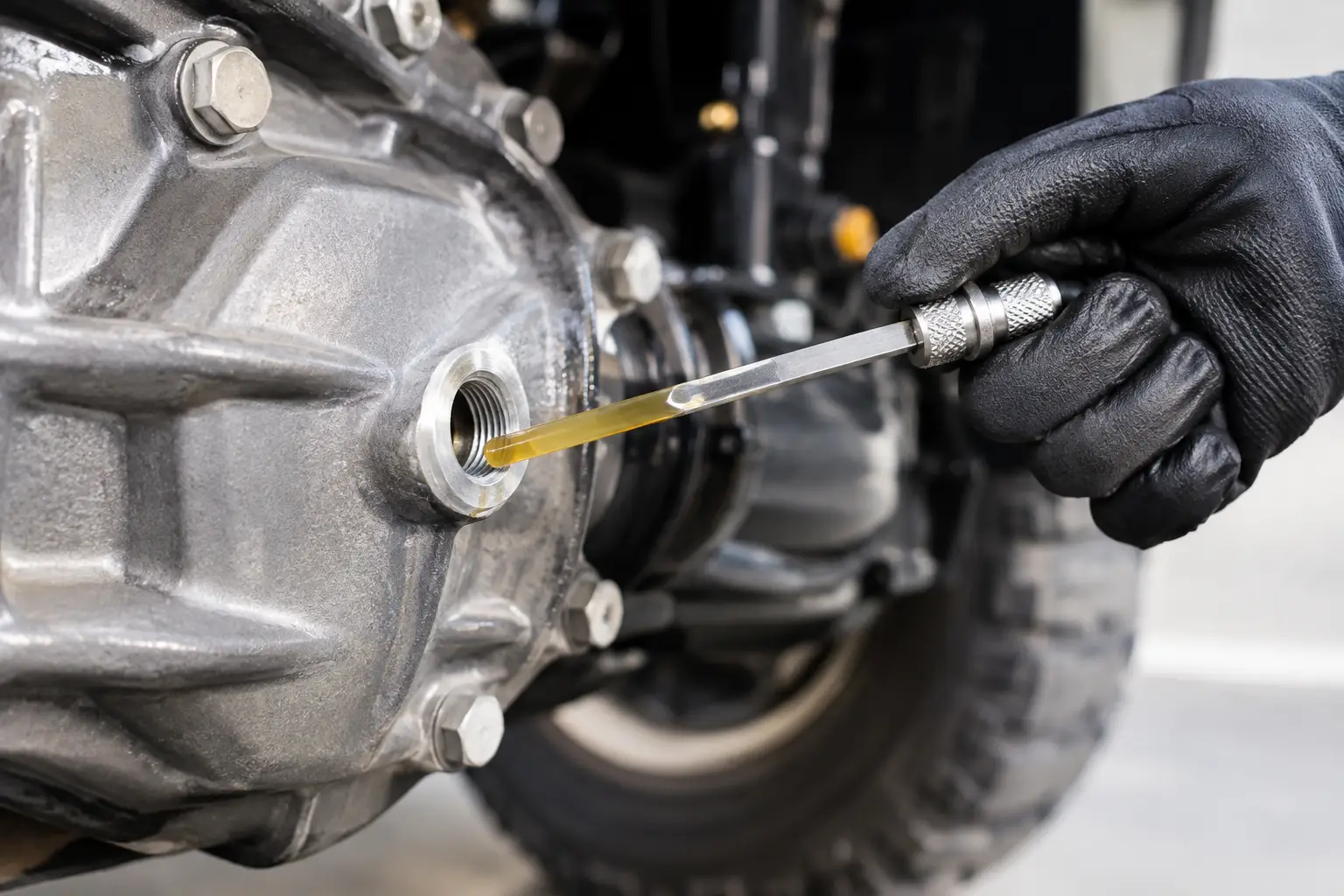
Most differentials and many transfer cases use a fill plug on the side of the housing. The proper level is generally at or just below the bottom edge of that fill opening when the vehicle is level.
Start by cleaning the area around the fill plug. Dirt falling into the housing can contaminate the lubricant, and a clean surface makes it easier to spot fresh leaks later. Always loosen the fill plug before removing a drain plug. If the drain plug comes out first and the fill plug is seized, you could be left with an empty component that cannot be refilled.
Remove the fill plug carefully. A properly filled unit may release a small amount of lubricant at the opening. If it does not, insert a clean gloved finger or a short plastic zip tie into the hole. You should be able to feel lubricant very close to the bottom of the opening. A level slightly below the opening can be normal, but a dry finger or a level well below the hole calls for attention.
If the level is low, do not simply top it off and forget it. Check the housing gasket, cover bolts, axle seals, pinion seal, vent tube, driveshaft area, and transfer case output seals for evidence of leakage. A wet housing may be old residue, but fresh fluid collects dirt and usually points to an active problem.
Add only the specified lubricant, and add it slowly until the level reaches the bottom of the fill opening. Install the plug with its correct sealing washer, thread sealant, or O-ring as required. Tighten it to the manufacturer’s torque specification. Over-tightening can strip an aluminum case or damage plug threads, turning a basic service into a housing repair.
Checking a Manual Transmission
Many manual transmissions also use a side-mounted fill plug and the same level-check method. However, their fluid requirements vary widely. Some units call for a lighter fluid than axle gear oil, and synchronizers may be sensitive to the lubricant’s chemistry and viscosity.
Use the manufacturer’s specified fluid and service procedure. If the transmission has a dipstick, follow the dipstick marks and temperature instructions rather than relying on a fill-plug rule. A transmission that shifts hard, grinds, whines, or pops out of gear should not be treated as a simple low-fluid issue. Check the lubricant, but diagnose the mechanical cause before damage spreads.
Inspect the Oil, Not Just the Level
Fluid level tells only part of the story. Gear oil should look like a consistent lubricant film, not a mixture of water, metal, sludge, or burnt deposits. New gear lubricant can range from light amber to dark brown, while used fluid often darkens with service. Color alone does not determine whether it is usable.
Look for a milky or foamy appearance, which can indicate water contamination. This is common after deep-water crossings, failed vents, damaged seals, or equipment that sees wet, muddy conditions. Water reduces film strength and promotes corrosion on gear teeth and bearings. Replace contaminated lubricant promptly and locate the entry point.
A strong sulfur-like odor can be normal for some extreme-pressure gear lubricants. A sharp burnt smell, however, may signal overheating. Towing beyond capacity, oversized tires, heavy hauling, aggressive driving, poor gear setup, or insufficient lubricant can all push differential temperatures beyond what the oil can manage.
If you are changing the oil, inspect the drain plug magnet. Fine gray paste is typically normal break-in or wear material. Large flakes, sharp chips, bronze-colored particles, or heavy metal buildup are not normal. Those findings warrant a closer inspection before refilling and returning the equipment to hard service.
When Checking Is Not Enough
A low level, contaminated oil, or metal debris is a service signal. Noise is a diagnostic signal. Whining during acceleration or deceleration, rumbling while turning, clunking on gear changes, vibration near the driveshaft, and binding in tight turns can all point to drivetrain problems that lubricant alone will not fix.
Limited-slip differentials deserve particular attention. If the vehicle chatters or grabs during slow, tight turns, confirm that the correct limited-slip lubricant or required additive was used. Adding an unapproved modifier to a differential that does not call for it can compromise performance, so follow the axle manufacturer’s requirements exactly.
For fleet trucks, farm equipment, towing vehicles, side-by-sides, and machines that work in dust, water, heat, or severe loads, routine checks should be more frequent than the minimum owner’s manual interval. Severe service shortens lubricant life. A scheduled inspection after a demanding season, a water event, a major towing job, or abnormal noise can prevent unplanned downtime.
Choose Lubricant for the Job, Not the Shelf
The right gear lubricant must match the required viscosity, performance classification, friction requirements, and operating environment. A light-duty commuter and a loaded diesel pickup pulling equipment may share a basic viscosity recommendation, yet their heat load and service demands can be very different.
Premium synthetic gear lubricants are built to maintain viscosity across wider temperature swings, resist oxidation under heat, and provide strong film protection under load. That can be a practical advantage for operators who tow, haul, race, plow, run long highway routes, or depend on equipment that cannot afford downtime. Still, premium lubricant does not override the manufacturer specification or repair a damaged seal, bearing, or gear set.
Oil Jobber helps operators match AMSOIL gear lubricants and related drivetrain fluids to the equipment they run, from personal trucks and powersports machines to commercial fleets and heavy-duty applications. Accurate product selection protects components, supports service efficiency, and helps avoid the cost of using a one-size-fits-all fluid where it does not belong.
Make gear oil checks part of the same disciplined routine as checking engine oil, coolant, tires, and filters. A few minutes under the vehicle can reveal a small leak or early contamination while the fix is still manageable – and before a hard-working drivetrain is forced into a costly failure.